Fine-tuning ESM3 as Inverse Folding Model (EphB1)
Architecture Breakdown
Data: ~9.2k EphB1 homologs with AF3-predicted structures. The pipeline: MSA → gap stripping → AF3 folding → atom37 coords + VQ-VAE structure tokens → MSA → Dataset. Custom collator pads both sequences and structures per batch.
Models: ESM3 with LoRA (r=4), structure-conditioned — all sequence positions masked, model predicts from structure alone → generative_modeling. This is an instance of the Fine-tuning module (inverse folding variant).
Sampling: None (training only).
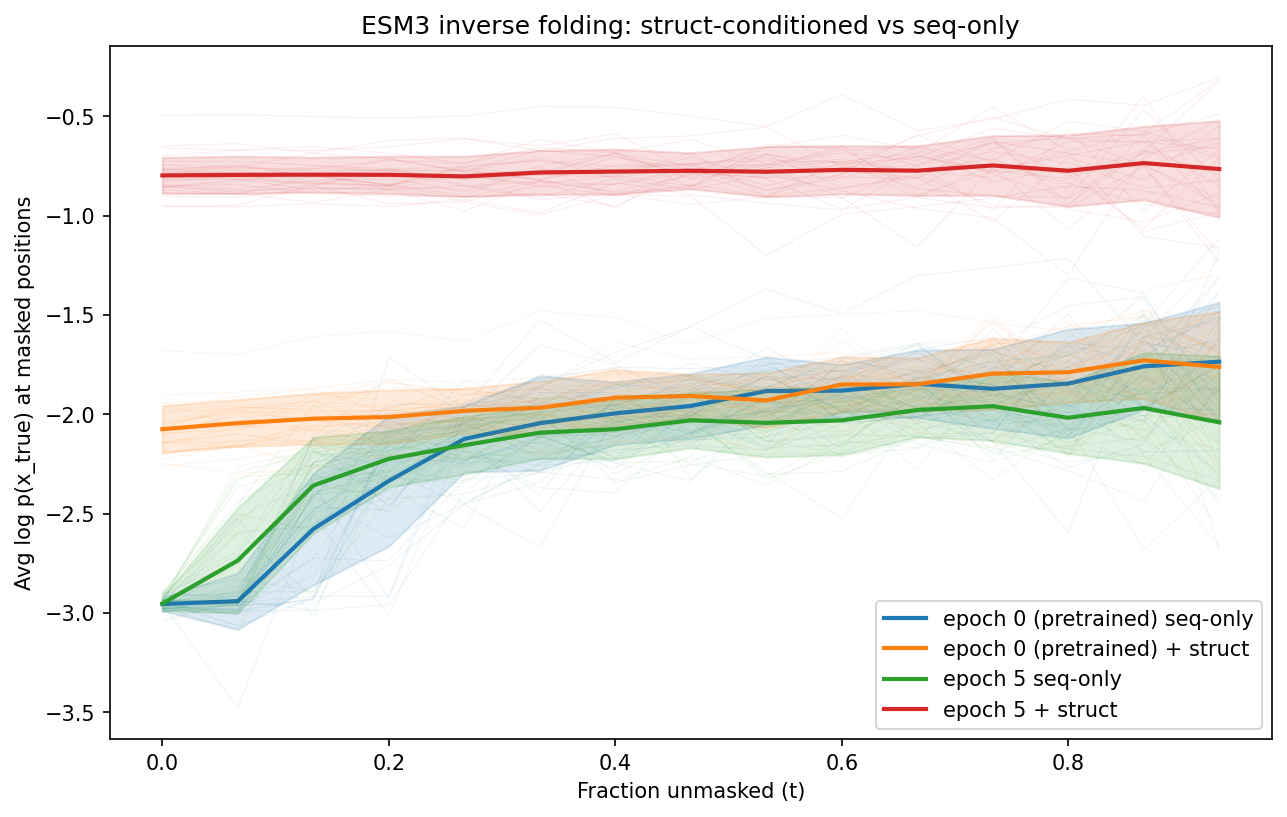
Evaluation: Per-epoch likelihood curves comparing structure-conditioned vs. sequence-only prediction → Likelihood Curves. Key metric: structure-conditioned log-prob at t=0 (fully masked).
The full pipeline: fold MSA sequences with AF3, then fine-tune ESM3 to predict sequence from structure.
Acknowledgement
We thank Kosuke Seki for providing the EphB1 MSA dataset used in this example.
Citation: Seki, K. et al. (2025). bioRxiv preprint. https://doi.org/10.1101/2025.08.03.668353 (link).
Prerequisites
AF3 Server
Step 1 requires a running AF3 inference server. Install the client package:
# From the proteingen repo — already listed as a dev dependency
uv sync

# Or install standalone
uv pip install git+https://github.com/ishan-gaur/af3-server.git
Then start the server on a GPU node (see the af3-server README for full setup):
Step 1: Fold MSA sequences
# Fold all sequences (runs ~80h for 10k sequences, saves incrementally)
uv run python examples/finetune_esm3/fold_msa_domains.py \
    --server-url http://localhost:8080
Step 2: Train inverse folding model
Results
Evaluates both structure-conditioned and sequence-only likelihood curves at each epoch. Results on ~9.2k EphB1 structures:
| Epoch | Loss | PPL | Struct log p (t=0) | Seq-only log p (t=0) |
|---|---|---|---|---|
| 0 | — | — | -2.075 | -2.955 |
| 5 | 0.572 | 1.77 | -0.798 | -2.953 |
The structure-conditioned model improves from -2.075 to -0.798 while sequence-only stays flat at -2.95, confirming the model learns to use structure information.
See the Fine-tuning workflow and MSA → Dataset workflow for the full walkthrough.
Source: examples/finetune_esm3/