Evaluating Models with Likelihood Curves
Likelihood curves measure how well a model predicts masked amino acids as more of the sequence is revealed. They provide a principled evaluation of model quality that works for both sequence-only and structure-conditioned models.
How it works
At each noise level t ∈ [0, 1):
- Mask each non-special position with probability
(1 - t) - Run the model forward on the masked sequence
- Measure the average log probability assigned to the true token at masked positions
At t ≈ 0: nearly everything is masked — the model must predict from minimal context (or from structure alone in the conditioned case).
At t ≈ 1: nearly everything is revealed — the model has rich context.
A better model produces higher log probabilities at every noise level.
Basic usage
from proteingen.eval.likelihood_curves import (
    compute_log_prob_trajectory,
    plot_log_prob_trajectories,
)
from proteingen.models.esm import ESMC

model = ESMC("esmc_300m").to("cuda").eval()

sequences = ["MVLSPADKTNVKAAWG...", "GPAVREYLK..."]

trajectory = compute_log_prob_trajectory(
    sequences=sequences,
    model=model,
    n_time_points=20,
    batch_size=8,
)

plot_log_prob_trajectories(
    trajectories=[trajectory],
    labels=["ESMC-300m"],
    output_path="likelihood_curves.png",
)
This produces a plot with:
- Mean curve (bold line) ± standard deviation band
- Individual sequence curves (faint lines behind the mean)
Comparing conditions
Plot multiple models or conditions on the same axes:
# Compare pretrained vs fine-tuned
traj_pretrained = compute_log_prob_trajectory(sequences, pretrained_model, n_time_points=20)
traj_finetuned = compute_log_prob_trajectory(sequences, finetuned_model, n_time_points=20)

plot_log_prob_trajectories(
    trajectories=[traj_pretrained, traj_finetuned],
    labels=["Pretrained ESMC", "Fine-tuned ESMC"],
    output_path="comparison.png",
    title="Pretrained vs fine-tuned on EphB1",
)
Structure-conditioned evaluation
For inverse folding models, you want to compare structure-conditioned vs sequence-only predictions. This requires calling the model's forward directly with structure tokens:
@torch.no_grad()
def eval_with_structure(model, sequences, structure_tokens, coordinates, ...):
    # Mask sequence positions
    noised = true_tokens.clone()
    noised[to_mask] = mask_token_id

    # Forward WITH structure
    raw = model(noised, structure_tokens=struct_tokens, coordinates=coords)
    logits = model.format_raw_to_logits(raw, noised, ...)
    struct_log_probs = F.log_softmax(logits.float(), dim=-1)

    # Forward WITHOUT structure (same masked sequence)
    raw = model(noised)
    logits = model.format_raw_to_logits(raw, noised)
    seq_only_log_probs = F.log_softmax(logits.float(), dim=-1)
The finetune_inverse_folding.py example does exactly this at the end of each epoch, producing side-by-side comparisons:
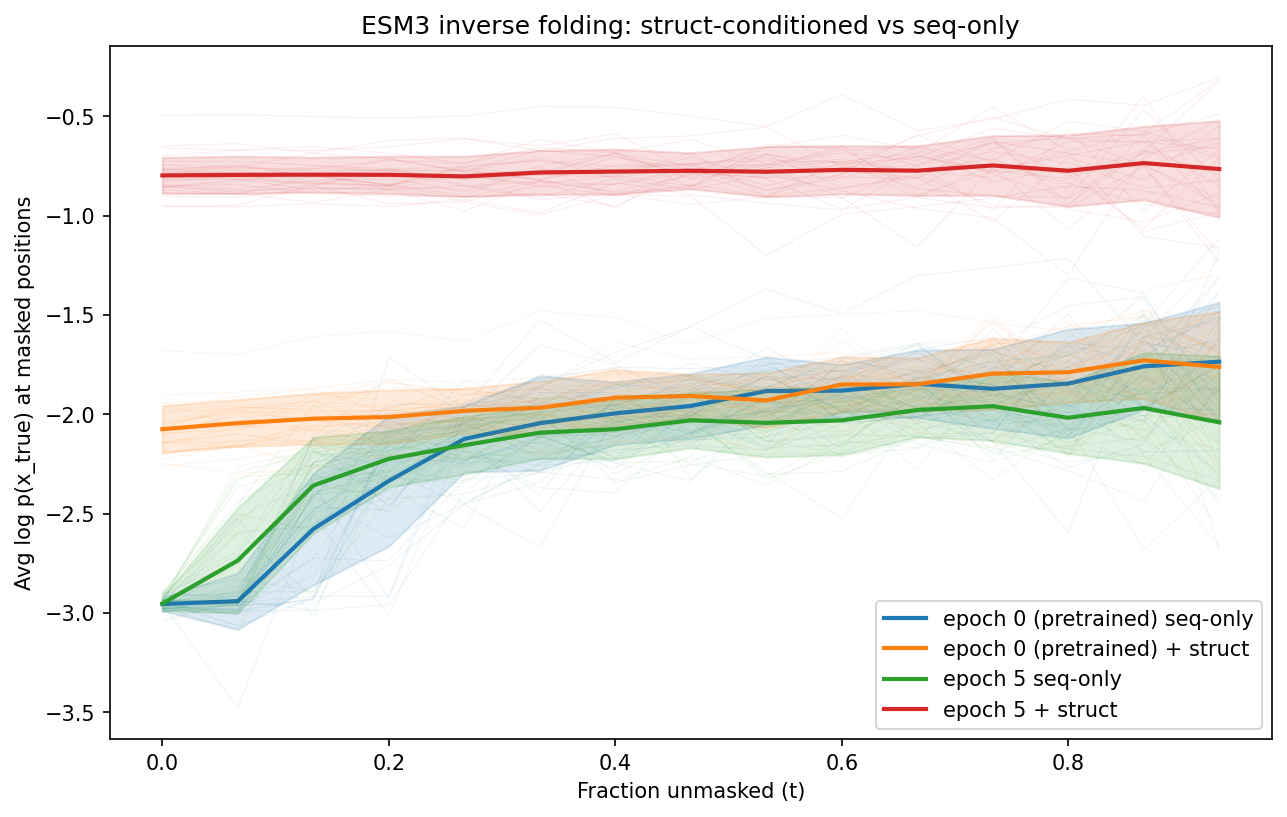
The fine-tuned model with structure conditioning (red) achieves much higher log probabilities than sequence-only (green/blue), confirming the model learned to use structural information.
Interpreting the results
| Pattern | Interpretation |
|---|---|
| Struct >> seq-only at all t | Model uses structure effectively |
| Struct ≈ seq-only | Structure conditioning isn't helping — check data pipeline |
| Curves flat across epochs | Model isn't learning — check learning rate, data size |
| Curves improve then plateau | Model has converged — stop training |
| Seq-only improves with IF training | Model is memorizing sequences, not learning structure |
The LogProbTrajectory type
Both compute_log_prob_trajectory and custom eval functions return a LogProbTrajectory:
class LogProbTrajectory(TypedDict):
    time_points: torch.Tensor    # (n_time_points,)
    avg_log_probs: torch.Tensor  # (n_sequences, n_time_points)
avg_log_probs[i, j] is the average log p(true token) at masked positions for sequence i at noise level time_points[j]. NaN where a sequence had no masked positions at that noise level.
Logging to wandb
Log summary metrics per epoch for tracking over training:
mean_lp = torch.nanmean(trajectory["avg_log_probs"], dim=0)

wandb.log({
    "eval/struct/log_prob_t0": mean_lp[0].item(),       # fully masked
    "eval/struct/log_prob_mid": mean_lp[len(mean_lp)//2].item(),  # half masked
})

# Upload the comparison plot
wandb.log({"eval/likelihood_curves": wandb.Image("curves.png")})
Track log_prob_t0 (fully masked) as the headline metric — it measures the model's ability to predict sequence from context alone (or from structure alone in the inverse folding case).
Full example
See examples/trpb_likelihood_curves.py for a complete standalone script that evaluates ESMC on the TrpB fitness dataset. Run with: